
The book
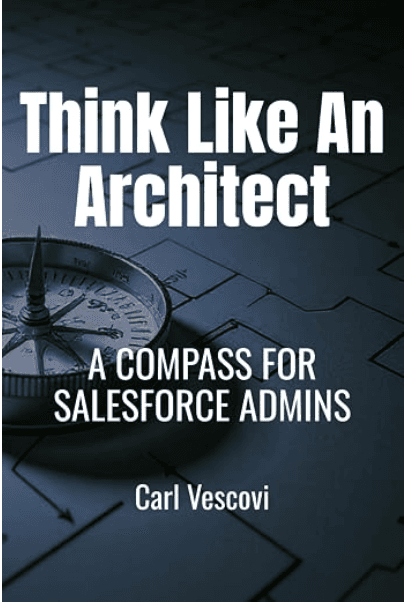
Think like an Architect gives your admins the frameworks I use.
Fractional Salesforce advisory
Independent Salesforce advice for the decisions that carry the cost, without hiring an architect or another delivery team.
Carl Vescovi — 22+ years in the Salesforce ecosystem, across clients, partners, and Salesforce.
Warren Buffett
Finding the value in Salesforce matters more than ever. Australian business margins are at their lowest since June 2020, with costs rising more than twice as fast as the prices businesses can charge. Salesforce raised its list prices by an average of 6% in August 2025, and AI is pushing spend higher still. Your spend shouldn’t go up unless the value you get goes up at least as much.
Getting that value means taking a hard look at what you already have, and making the licences, features and data you pay for work harder.
You may be seeing:
This is advice and judgement. It is the wrong fit if you need hands-on configuration or development capacity. Even when I run the decisions and the backlog, your team or partner still does the building.
A permanent Salesforce architect in Australia costs around $200,000 a year in base salary, before super, on-costs, recruitment and the months it takes to hire one. Most organisations don’t have that much architecture work to give them.
The alternative is usually worse: no architect in the room when the big decisions get made. Then the partner designs the solution it will be paid to build, the licence renewal goes through unchallenged, and today’s shortcut becomes next year’s rebuild.
I sit between those two options. You get senior judgement on the decisions that carry the cost, for as many days as those decisions need.
Continuity matters too, especially with AI. Real value from AI takes a thorough understanding of your business and how its workflows run, and that doesn’t come from one-off engagements. A retainer builds that understanding month after month, in a way a traditional partner moving from project to project can’t.
For organisations with material Salesforce spend, an admin or partner doing the work, and no architect of their own.
Scope and cost are agreed in the first conversation.
Think like an Architect gives your admins the frameworks I use.
I advise and you decide, for set days each month on a rolling basis. Each month ends with a clear list of what to fund, stop or challenge.
Start a conversationI run the decisions and the backlog, and your team or partner does the build. You get release and security review, and a roadmap I’m accountable for. Subject to availability.
Check availability
I’ve spent more than 22 years in Salesforce, working for clients, for partners and for Salesforce itself. I don’t resell licences or take on builds, so my advice has no stake in how much you spend.
Author of Think like an ArchitectBrought in to a multi-million-dollar project at a peak body, up to six months overdue and nowhere near delivered. Reset the scope, roadmap, team and design, and it landed on the desired outcome within the time and budget I proposed.
Brought a significant not-for-profit’s fragile e-commerce build onto a modular, secure, Salesforce-native solution, with no disruption to the business. Fewer platforms cut cost, simplified administration and made the solution more robust.
Designed a reusable UI framework for a public sector organisation’s portals, built on native Salesforce capability. It avoided add-on licences and delivered beyond the initial scope.
Tell me the decision in front of you: a renewal, a partner proposal, a rebuild, or whether the platform is earning its keep.